Foundation Paper Piecing: Love It, Hate It, or Just Tolerate It?
Updated: Aug 20
Foundation Paper Piecing — or FPP, as those of us who have spent far too much time removing tiny bits of paper from the back of a quilt like to call it — is one of those quilting techniques that seems to divide quilters into two very distinct camps.
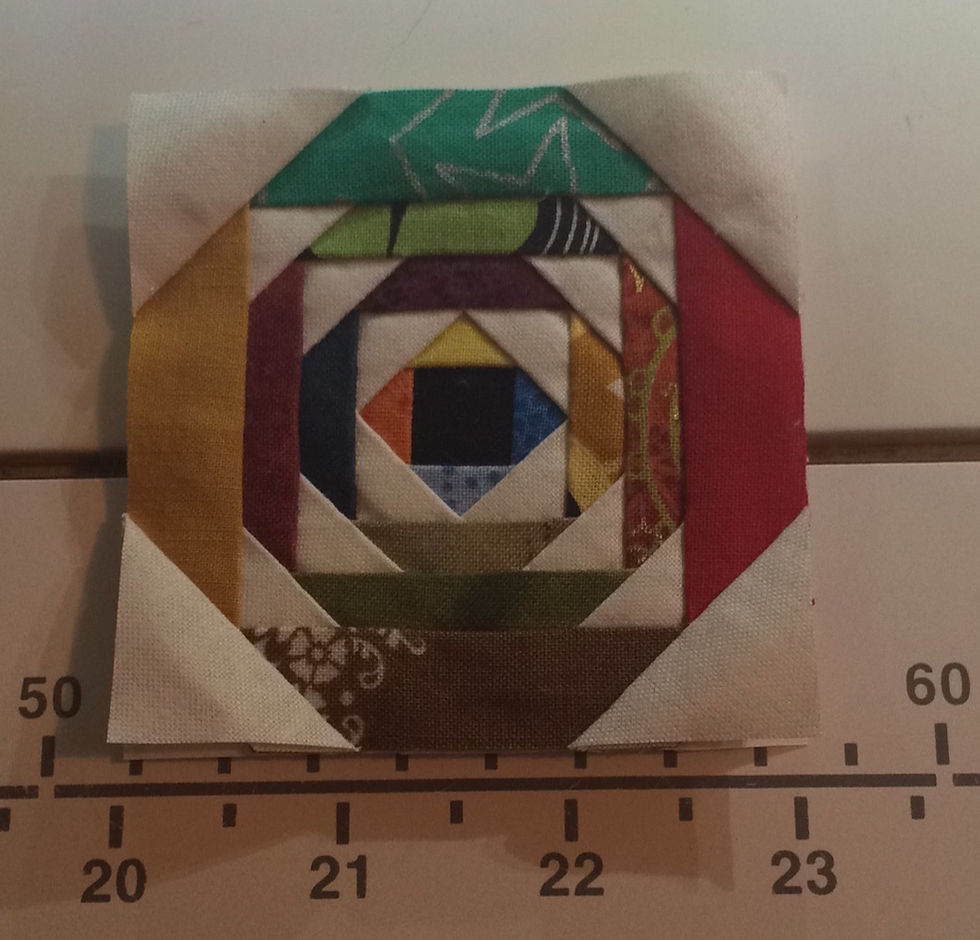
There are the people who say:
“I LOVE foundation paper piecing!”
And then there are the people who hear those words and immediately think:
“Why on earth would anyone willingly sew through paper?”
And honestly?
I understand both sides.
Foundation Paper Piecing can produce incredibly precise, complicated designs that would be difficult, and sometimes nearly impossible, to piece using traditional methods.
But it can also involve tiny fabric pieces, lots of thread, paper everywhere, seams that need to be ripped out of paper, and the occasional moment when you realize you have sewn a piece of fabric on backwards.
Which is always fun.
So let’s talk about what FPP actually is, why people love it, why people hate it, and the different types of foundation piecing you might encounter.
Because, like most things in quilting, there isn’t really one right answer.
So What Exactly Is Foundation Paper Piecing?
The basic idea behind traditional Foundation Paper Piecing is pretty simple.
Instead of cutting every fabric piece to an exact shape and then trying to sew those pieces together accurately, you sew the fabric onto a foundation that has the sewing lines printed on it.
The foundation acts as a guide.
You sew directly along the printed line, which means the foundation is essentially telling you:
“Sew here.”
And because you are sewing on the line rather than trying to perfectly match two oddly shaped pieces of fabric together, you can achieve an incredible amount of accuracy.
This is particularly useful for things like sharp points, tiny pieces, unusual angles and intricate designs.
The process usually involves placing a piece of fabric behind the paper, sewing along the appropriate line, flipping the fabric, pressing it, and then adding the next piece.
Repeat.
And repeat.
And repeat.
Until you have a block.
Then you remove the paper.
And that’s where things get interesting.
Why People LOVE FPP
1. The Accuracy Is Fantastic
This is probably the biggest advantage.
If you have ever tried to piece a complicated star traditionally, you know that getting all those points to meet perfectly can be challenging.
FPP gives you a printed sewing line to follow.
You don’t have to calculate the angle.
You don’t have to worry quite as much about whether that point is going to end up where it should.
You simply sew on the line.
Well…
You simply sew on the line accurately.
There is still room for user error.
Ask me how I know.
2. It Makes Complicated Designs Possible
Some quilt designs would be incredibly difficult to piece using traditional methods.
Think:
· Very sharp angles
· Tiny points
· Curved-looking geometric designs
· Intricate stars
· Animals
· Houses
· Flowers
· Letters
· Geometric artwork
· Extremely detailed blocks
FPP opens up a whole different world of design possibilities.
It allows a designer to create shapes that would otherwise require some serious gymnastics with fabric.
And that is one of the things I really enjoy about it.
You can take an idea that looks almost impossible and turn it into a series of very manageable little sewing lines.
3. Small Pieces Become Less Scary
This one sounds strange because FPP is often associated with tiny pieces.
But sometimes tiny pieces are actually easier with FPP.
When you’re traditionally piecing a tiny triangle, you have to cut that triangle accurately, handle it carefully and sew it with a precise seam allowance.
With FPP, the paper tells you where to sew.
The fabric is cut oversized.
The final shape is created by the sewing.
That can make very small and complicated sections considerably easier to manage.
4. Your Points Can Be Ridiculously Good
There is something very satisfying about a beautifully pieced FPP block.
The points are sharp.
The angles are crisp.
The design lines line up.
Everything looks intentional.
And when it works?
Oh, it’s good.
You sit back and admire it for a moment.
Then you realize you have 19 more sections to make.
But let’s not ruin the moment.
Now Let’s Talk About Why People DON’T Like FPP
Because there are some legitimate complaints.
And I don’t think we should pretend otherwise.
1. The Paper
Oh, the paper.
Some people love it.
Some people tolerate it.
Some people would happily pay someone else to remove it.
You sew through the paper while constructing the block and then, depending on the type of foundation you are using, you generally have to remove that paper afterward.
And that means picking at seams.
Pulling tiny pieces.
Tweezering little bits out of corners.
Finding one microscopic piece of paper that somehow survived three washings and has apparently decided it now lives permanently inside your quilt.
It can be tedious.
Especially with a large project.
2. You Sew Through the Paper
This sounds obvious, but it changes the sewing experience.
Your needle is going through fabric and paper.
That means your needle can dull faster, and many FPP instructions recommend using a shorter stitch length so the paper perforates more easily.
That shorter stitch length is useful.
It is also extremely helpful when you discover that you made a mistake.
Because now you’ve essentially created a perforated line through which you can carefully rip out the seam.
And by “carefully,” I mean:
try not to rip the fabric while removing the paper.
3. There Is More Fabric Waste
This is one of the biggest disadvantages.
With traditional piecing, you can often cut your pieces fairly close to their finished size.
With FPP, fabric is generally cut larger than the finished section so you have enough fabric to cover the area when it is sewn.
That means there are scraps.
Lots of scraps.
Tiny scraps.
Oddly shaped scraps.
Scraps that are far too small to use for anything but somehow you cannot bring yourself to throw them away.
Because obviously they might be useful someday.
This is quilting.
We know how this goes.
4. It Can Feel Backwards
If you’ve never done FPP, the process can feel completely backward.
You are looking at a piece of paper.
The fabric is on the back.
You’re sewing on the front.
You’re trying to figure out where the fabric will end up when you flip it.
And then you’re adding another piece.
And another.
Eventually your brain stops trying to understand what is happening and simply trusts the process.
That is normal.
The first few sections can feel like solving a small puzzle.
Once you get the hang of it, however, it becomes much more intuitive.
The Different Types of Foundation Piecing
Here’s where things get a little more interesting because not all foundation piecing is exactly the same.
When people say “FPP,” they are often talking about traditional paper piecing, but there are several variations.
Traditional Paper Foundation Piecing
This is probably what most people picture when they hear FPP.
A paper foundation has printed sewing lines.
You place fabric behind the paper and sew directly on those lines.
After the section is completed, the paper is removed.
This is particularly useful for intricate geometric designs.
It’s also the version most likely to leave you sitting at the kitchen table surrounded by tiny pieces of paper.
Newsprint or Lightweight Paper
Some FPP patterns are printed on very lightweight paper designed specifically to be removed easily.
This can make the process much more pleasant because the paper tears away more readily.
Some quilters simply print their patterns on inexpensive copy paper.
Others swear by specialty foundation paper.
There are even people who have very strong opinions about which printer settings, paper weights and stitch lengths should be used.
Of course there are.
We are quilters.
We have opinions about everything.
Freezer Paper Foundation Piecing
Freezer paper is another option.
Instead of permanently sewing through the paper in exactly the same way as traditional FPP, freezer paper can be temporarily adhered to fabric and used as a foundation or guide.
One advantage is that the paper can sometimes be reused.
And because freezer paper can stick to fabric, there can be less shifting.
Some quilters love this method.
Others prefer traditional paper because they don’t want to introduce another material into the process.
As usual, there is no shortage of opinions.
Foundation Piecing on Fabric
Not every foundation is paper.
You can also foundation piece onto fabric.
This is sometimes useful when you want the foundation to remain permanently in the quilt.
It can provide stability and is particularly useful for certain types of projects.
The downside?
You now have another layer of fabric in your quilt.
That may be exactly what you want.
Or it may be exactly what you don’t want.
Improvised or “Add Your Own Seam Allowance” Foundation Piecing
Some FPP patterns are designed around very precise sections and include everything you need.
Others require you to understand the technique well enough to make adjustments yourself.
This is one reason I think learning how FPP works, rather than simply following a particular pattern, is so valuable.
Once you understand the process, you can adapt it.
You can resize things.
You can change fabrics.
You can sometimes combine sections differently.
And you become much less dependent on someone telling you exactly what to do.
FPP Isn’t Necessarily the Best Choice for Everything
This is worth saying.
Just because something can be foundation paper pieced doesn’t mean it should be.
Sometimes traditional piecing is faster.
Sometimes there is less fabric waste.
Sometimes the pieces are simple enough that FPP would just add unnecessary steps.
If I’m making a simple four-patch, I don’t need a foundation.
I need four squares.
And preferably a cup of coffee.
FPP really shines when it solves a problem.
When it gives you accuracy that would otherwise be difficult.
When it makes an intricate design achievable.
When the technique actually makes the project better.
So Why Do Some Quilters Become FPP Addicts?
Because once it clicks, it can be incredibly satisfying.
You can take a complicated-looking design and break it down into manageable sections.
You can get incredibly precise points.
You can create designs that would be difficult to achieve another way.
And there is something oddly addictive about watching a complicated little collection of fabric pieces gradually turn into something recognizable.
The first few blocks might have you saying:
“I don’t understand why anyone does this.”
A few blocks later:
“Ohhhhh.”
And eventually:
“Look what I made!”
And then, unfortunately, you discover an entire world of FPP patterns on the internet.
And suddenly you need a new quilt.
Again.
My Take on FPP
I think FPP is one of those techniques that is absolutely worth learning, even if you don’t fall madly in love with it.
You don’t have to become an FPP fanatic.
You don’t have to choose it over traditional piecing.
And you certainly don’t have to enjoy removing paper from 400 tiny seams.
But knowing how to use it gives you another tool in your quilting toolbox.
And that’s really what I love about quilting.
There isn’t one technique that has to be used for everything.
Sometimes traditional piecing is the answer.
Sometimes applique is the answer.
Sometimes FPP is the answer.
And sometimes the answer is:
“I’m going to put this project away for three days and pretend I don’t know where it is.”
That’s okay too.
Learn the technique.
Try it.
Decide what you like about it.
Decide what you don’t.
Use it when it makes sense.
Ignore it when it doesn’t.
Because quilting isn’t about proving that you can follow every technique perfectly.
It’s about making something.
And if foundation paper piecing helps you make something you couldn’t otherwise make, then it’s a pretty useful little trick to have up your sleeve.
Even if it does leave tiny pieces of paper all over your sewing.
(I just also want to say that I need to thank ChatGPT for helping me put my thoughts into a coherent post after over 40 minutes of voice rambling my thoughts on the subject).


Comments